When Love Refuses to Quit: The Radical Covenant That Changed Everything
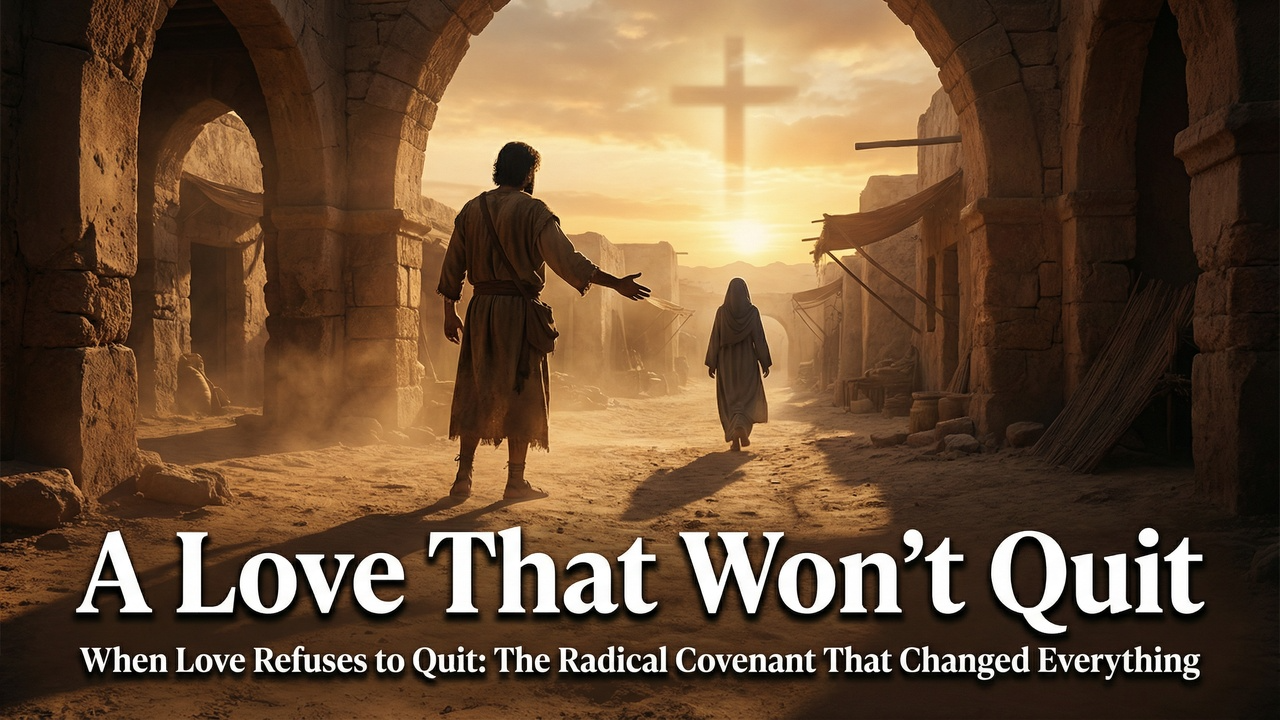
We live in a world on fire, and most of us are too distracted to notice the flames.
We're the most connected generation in human history, yet loneliness has become an epidemic. We have millions of followers but sleep alone. We build digital kingdoms while our souls crumble. We've mastered the art of saying all the right things—posting scripture, attending services, raising our hands in worship—while our hearts remain a thousand miles away from genuine surrender.
This is the uncomfortable truth we must face: We've learned God's name before we've learned His heart.
The Sound of Worship Without Surrender
There's a peculiar kind of grief that comes from proximity without intimacy. We can be physically present in sacred spaces while being emotionally and spiritually absent. We shout "holy" in the building, then chase whatever feels good in the street. We lift our hands on Sunday morning but live like God doesn't see us Monday through Saturday.
We've built a rhythm without surrender, a melody without truth.
The ancient story of Hosea and Gomer isn't just a historical account—it's a mirror held up to our own faces. It's the story of a prophet commanded to marry a woman who would betray him, not once, but repeatedly. God's instruction was clear and shocking: "Take a wife who is a prostitute."
Why would God ask such a thing?
Because His people loved Him exactly like she would love Hosea—faithful when watched, absent when tempted, saying His name publicly while selling devotion privately.
The Cost of Obedience
Hosea's obedience didn't come from understanding; it came from trust. When God gave him this impossible assignment, Hosea didn't pretend it made sense. He simply said, "I will obey."
This is where many of us stumble. We want God to explain Himself before we commit. We want the blueprint, the guarantee, the assurance that obedience won't cost us our reputation, our comfort, or our carefully constructed lives.
But covenant love doesn't ask the crowd for permission. It doesn't need approval to move forward. As Hosea discovered, you are not required to understand what you are called to love.
The marriage began without fantasy or illusion. Gomer brought her wounds, her survival mechanisms, her inability to trust safety. Hosea brought his commitment—not calm, but commitment. There's a profound difference. Calm is a mood that changes with circumstances. Commitment is a decision that holds steady when everything else shakes.
The Names That Tell the Truth
When their children were born—triplets, arriving one after another—each was given a name that carried prophetic weight:
Jezreel - "God plants, God scatters, God exposes what people bury."
Lo Ruhamah - "No mercy" (not as hatred, but as consequence).
Lo Ammi - "Not My people."
These weren't cruel labels; they were honest declarations about the season they were living in. Names name seasons, not destinies. They were truth-tellers in a time when everyone preferred comfortable lies.
The children grew up carrying these heavy names, asking questions that pierced: "Why do people look at me strange when they hear my name? Mama used to smile at me, but now she barely stays. Daddy says God's still with us, but why do I feel away?"
When Safety Feels Like a Trap
Gomer's struggle wasn't that Hosea was cruel or controlling. Her struggle was that he was safe, and safety felt foreign to someone who had survived chaos. Peace doesn't feel peaceful to people who learned to navigate life through turmoil.
"This life feels like a trap," she confessed.
Hosea's response cut through her defenses: "I don't trust safety because safety has never stayed."
"But I am here," he said simply.
And yet, she ran. Not because Hosea failed, but because she didn't know how to live in a life that didn't feel like survival. She returned to the streets, to the familiar bondage, to the place where chaos made sense.
The Purchase: Love's Most Radical Act
When God told Hosea to go after her again, it would have been the perfect moment to quit. She had chosen her old life. She had abandoned him and their children. She had proven that love wasn't enough to change her.
But God's instruction was clear: "Love her again."
Hosea found her in a holding area, makeup half-applied, eyes distant—not confident, but resigned. And there, in front of the pimp who claimed to own her, Hosea laid down cash. Then more. Then more.
"Love like yours is expensive," the pimp sneered.
"I was told that," Hosea replied.
This is the scandalous heart of the gospel: While we were still running, God was already coming. Not after we cleaned ourselves up. Not after we deserved it. Not after we understood it.
While we were still selling ourselves to lesser lovers, God was counting out the cost of our redemption.
The Love That Won't Quit
Hosea's words to Gomer echo across the centuries: "You are not my project. You are my covenant. If you fail again, I will grieve again. And I will still be here."
This is not the love we see in movies or read about in romance novels. This is covenant love—love that refuses to quit even when it's wounded, even when it's rejected, even when it looks foolish.
"I don't stay because you promise," Hosea explained. "I don't stay because you try. I stay because I said forever, even when forever hurts sometimes."
The Cross Makes It Clear
If you're wondering whether this kind of love is real, look at the cross.
God didn't send another message when humanity rejected Him. He came Himself. He put on skin. He walked into our streets. He let betrayal kiss Him on the cheek. He let nails finish the conversation we started in the garden.
We called it a cross. He called it a covenant.
We thought death would end it. He knew resurrection would finish it.
Easter isn't proof that we are good. Easter is proof that God stays—not after we fix ourselves, not after we understand, not after we deserve it. While we were still sinners, Christ died for us.
The Question We Must Answer
This story forces us to confront an uncomfortable question: Are we living in reciprocity with God, or are we just using His name?
Do we want the blessing without the change? Do we want Him close when trouble hits but distant when He corrects? Do we love His power but fear His presence?
The world is still on fire. We're still building kingdoms that can't last. We're still chasing shadows and bowing to screens. We're still screaming for attention while our souls starve for genuine connection.
But here's the hope that anchors everything: God has never been confused about our condition. He sees what we hide. He sees what we excuse. He sees what we call freedom that is slowly becoming fire.
And still, He stays.
This is a love that won't quit—won't let go, won't walk away, won't give up. A love that chased you down and called you back home. A love that paid your cost from the cross to the cross.
You weren't faithful, but He was. You weren't strong, but He was. You weren't there, but He was.
That's not weakness. That's love. Resurrection love. The kind that refuses to stay buried, refuses to stay silent, refuses to quit.
The empty grave and the open door are your invitation: He is still here.
Found this helpful?
Share it with someone who needs to hear this.